1. Save Social Security Without Cutting Benefits
It’s projected that the Social Security retirement trust fund will deplete its reserves in 2032. The expected payments will cover only around 78% of scheduled retirement benefits. Then, if Congress doesn’t act, benefits would need to be slashed by roughly 26%, according to the bipartisan Concretional Budget Office (the CBO) .
Under FICA, employees pay 6.2% of their wages for a Social Security payroll tax and 1.45% for a Medicare tax, with employers matching those amounts.
But the Social Security tax applies only to the first $184,500 of earnings. Earnings above that are aren’t subject to the tax. So, today, a person earning $1 million and a person earning $184,500 pay the same Social Security payroll tax, — another tax break for the wealthy.
Congress should increase Social Security revenues by eliminating the $184,500 cap for high earners and requiring them to pay Social Security taxes on more or all of their wages. It’s estimated that imposing the payroll tax on all earnings above $184,500 without providing additional benefits would eliminate around two-thirds of Social Security’s projected shortfall.
2. Lower inflation by reducing the Federal Deficit
The CBO projects the federal deficit to reach $2.0 trillion after the 11thmonth of fiscal year 2026 ending September 30th. It also projects annual deficits to reach $3.1 trillion in 2036 and that Federal debt held by the public will rise from 101% of GDP to 120% of GDP in the same year, which almost certainly will raise interests and begin a migration of investors to other currencies.
To lower the deficit we need to spend less, raise taxes or a combination of both.
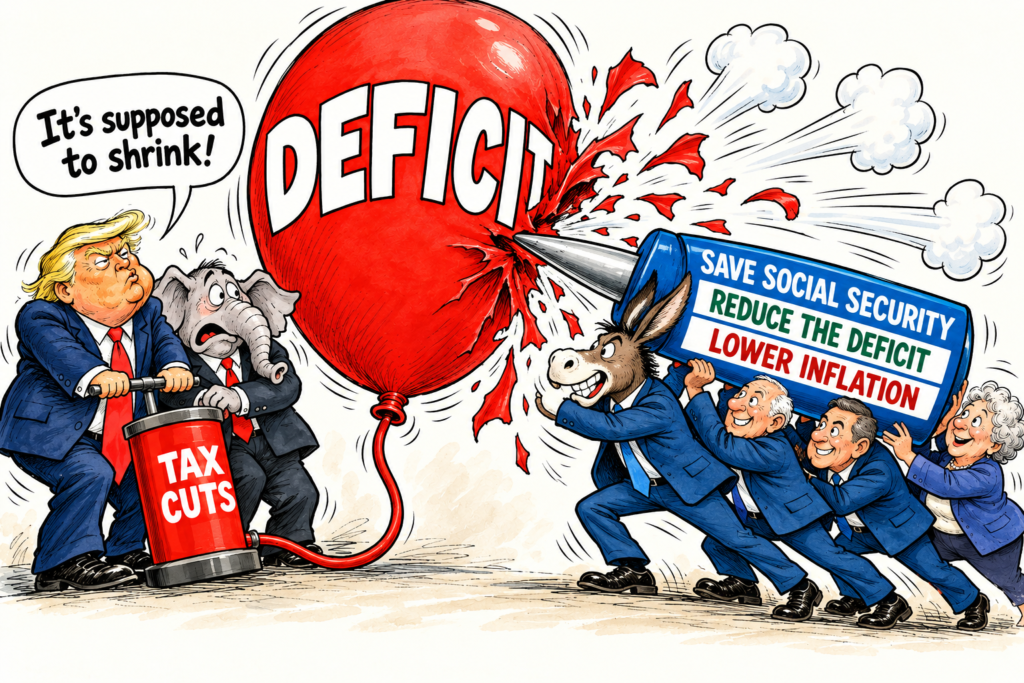
The 2017 tax law enacted during Trump’s first term reduced the top federal individual income-tax rate from 39.6% to 37%, and made it permanent in 2026. But, sadly, Trump’s One Big Beautiful Bill cut benefits of programs for the needy, including Medicaid and SNAP. In other words, the One Big Beautiful Bill took money from Medicaid, SNAP and other programs to replace the tax revenues lost from the tax cuts for America’s wealthiest.
Instead of cutting benefits for the needy, Congress should, in addition to raising the Social Security tax for those with the greatest ability to pay, spend less by making the government operate more efficiently. A likely response will be “We’ve heard that before!”
But that was exactly President Clinton did under his National Performance Review of Government. After examining government agencies and other functions, the review recommended eliminating unnecessary programs, consolidating overlapping activities, streamlining bureaucracy and the delivery of government services.
Although the result wasn’t a home run, the National Performance Review improved government practices enough to reduce the federal workforce and some operating expenses. The Clinton administration identified approximately $108 billion in projected savings for fiscal years 1995 through 1999.
The independent, nonpartisan Brookings Institution judged the workforce savings to be substantial. And the government ran a surplus for fiscal years 1995 through 1999, which contributed to strong tax revenues from a growing economy and a rising stock market.
An important feature of the National Performance Review was that it relied heavily on the people who actually worked inside the federal government as opposed taking the DOGE ax to government functions without evaluating them first.
So it was unnecessary for Trump to dismantle federal agencies, look to national safety nets to replace lost tax revenues, cut foreign aid resulting in 700,000 deaths – including 250,000 children–, and the agencies that predicted and rescued victims of disasters.
Many economists believe that if Congress doesn’t act, then following the Fed’s recent increase in the Federal funds rate, interest rates will continue to rise across the board, including on home mortgages and car loans, and lead to higher interest costs on Treasury debt and higher deficits. So, something a kin to a National Performance Review is urgent to slow inflation and save Social Security.
A problem is President Trump’s chicanery. He promises that tax cuts will generate enough additional economic growth to increase tax revenues that will substantially or completely offset any increase in the deficit. Specifically, he estimated $2.1–$2.3 trillion in deficit reduction from higher growth attributable to the tax cuts of his One Big Beautiful Bill. In contrast to Trump and Republican promises, the CBO estimated that the bill would increase – not reduce — deficits by about $2.8 trillion over that period. The Tax Foundation, giving some optimism to favorable growth, estimated that it would offset the lost tax revenue by only 19% — not 100%.
Trump and the Congressional Republicans promised five times before, starting with President Reagan, that their tax cuts would generate enough economic growth to cover the lost tax revenues. They never did.
Congress has not passed a serious and comprehensive tax reform bill since 1986, when Ronald Reagan was President. It’s time the did.
Twitter (X):