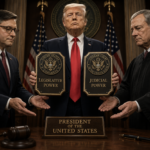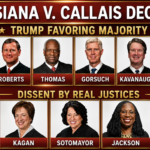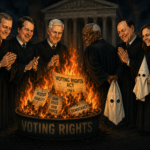
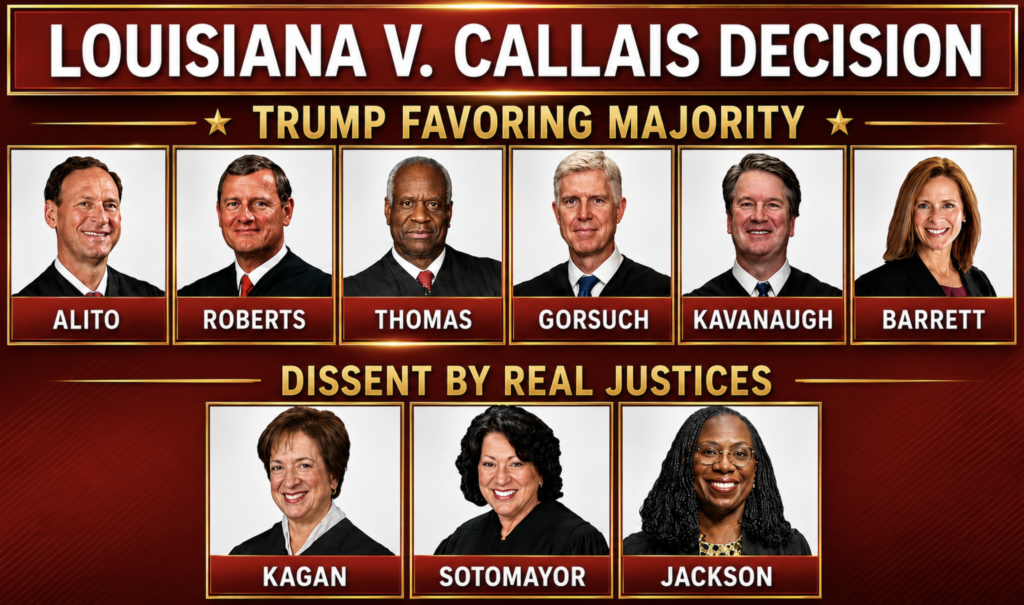
It’s up to Republican voters to decide between democracy and exploiting the shameful advantage the Supreme Court’s Trump-favoring majority gave them. It butchered the Constitution and the Voting Rights Act (“VRA”) to allow Louisiana and Alabama lawmakers to discriminate against Black and other minority voters by redrawing their district maps. Trump and Republican states rushed to accommodate the racist decision that rendered minority votes meaningless.
In an effort to put the final nail the VRA’s coffin, the Supreme Court sent back to lower courts two cases that had suggested that only the Justice Department could bring enforcement actions under the law barring racial discrimination in voting. That was a 180 degree turn away from its prior holdings. Indeed, the Supreme Court has heard VRA cases brought by voters.
If Republican voters choose democracy, they should not vote for the candidates forced upon them by the Supreme Court’s racist majority. Otherwise, they accept the brazen rigging of elections and tear up our democracy by its roots – the right to vote.
Democracy gives voters the choice of who governs them. It cannot exist if elected politicians are allowed to make that choice. But that’s what Trump’s majority just allowed.
There’s a history behind why and how the Supreme Court majority is willing to pervert the Constitution, the VRA, and America’s other core values.
Republican extremist Leonard Leo, as chairman of the ultra-conservative Federalist Society, armed it with $1.6 billion to stack the Court with a majority that butchered the Constitution to turn their personal policies into law. Justice Thomas once joked (remember, humor is a vehicle for truth) that Leo was the “number 3 most powerful person in the world.”
Leo’s Supreme Court appointees — Justices Roberts, Kavanaugh, Gorsuch, Thomas, Alito, and Barrett — were promoted by him and the Federalist Society to place their proxies on the Court. Holding that the Constitution and the VRA allowed states to racially gerrymander was at the top of their list.
It didn’t stop there. Leo and the Federalist Society had other priorities that his majority turned into law:
Keeping Trump in office:
• Trump’s majority gave him broad immunity and delayed his D.C. criminal trial until after the 2024 election so voters wouldn’t know if they were voting for a convicted felon.
• The majority struck down Section 4(b) of the VRA, which required states with histories of suppressing minority voting to clear voting-law changes with federal authorities. They relied on the 10th Amendment, which doesn’t mention elections. The 15th Amendment, which they hardly mentioned, expressly prohibits racial gerrymandering and gives Congress the power to enforce that prohibition. Requiring federal pre-clearance for states with a history of racial voter suppression would seem to fall directly within that power. Instead, the Court’s majority invoked the antiquated theory of equal sovereignty (“ES”), which requires the federal government to treat states equally. But ES is nowhere in the Constitution; it’s not even a law. It was originally invented to prohibit different criteria for admitting states into the Union.
Deregulation of corporations: The Supreme Court had previously held that courts should defer to the interpretations of executive agencies created and authorized by Congress to issue regulations under federal laws. The Supreme Court’s majority nixed that and transferred the authority to interpret legislation from executive agencies to the judiciary, which sorely lacks the personnel and expertise to do the job. It was the Court’s way of freeing corporations from regulations issued by executive agencies and, not surprisingly, it unleashed a slew of corporate lawsuits challenging agency interpretations. Corporations are now free to ignore regulations issued by executive agencies until the courts decide how they should be interpreted, which could take years – exactly what Leo and the Federalist Society wanted.
Overturning Roe v. Wade: That’s history too well known.
The entire majority is conflicted because it repeatedly rules in favor of the policies of Leo and the Federalist Society rather than as required by the Constitution. In Caperton v. Massey, the Supreme Court held that “every case … which would offer a temptation to the average man … not to be impartial … denies … due process of law.” Would Leo’s appointees feel beholden to the patron and his proxy who got them on the bench and be tempted to favor their agenda? You bet they would.
Twitter (X): https://x.com/ChaosPolicy/status/2056772761671098414?s=20