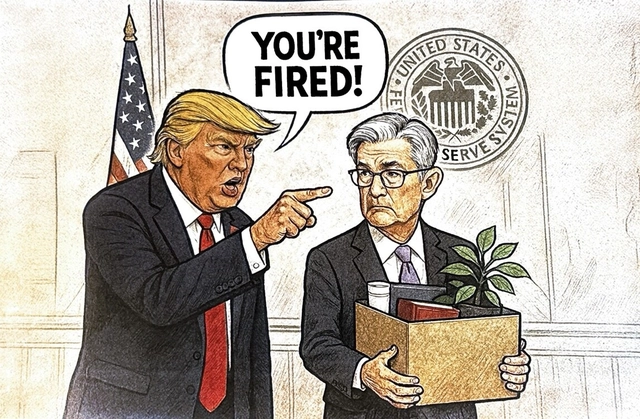
Trump wants the Fed to lower interest rates to boost the economy and the stock market leading into the primaries, even though it will super-charge inflation and raise consumer prices. To intimidate Fed Chairman Powell into lowering rates, he opened a criminal investigation based on a spurious claim that Powell lied about the scope and cost of the renovation of the Fed’s DC’s office building. The move fits a pattern of ignorance, evil or willingness to sacrifice America’s economy for his own benefit.
Although workers in 19 states have received an increase in their minimum wage to $15 per hour while the rest of Americans will work for a federal minimum wage of $7.25, the increases are not enough to cover middle and low income earners’ basic expenses. Prices projected to keep rising include beef, coffee, eggs, dairy and sugar.
Trump has put Stephen Miran, a close advisor of Trump, on the Fed’s board of governors. Shocking, Miran will stays in the administration as a Trump advisor while he’s a mole on the board for the President. Trump is also trying to fire Lisa Cook, a Biden-appointed governor, claiming that she’s committed mortgage fraud, but the Supreme stopped him until it hears the case.
And if Trump’s compliant Supreme Court majority allows him to replace Cook, he’ll hold a majority on the Fed. Then Trump won’t need to pressure anyone – he’ll make interest rate decisions himself, and inflation is sure to follow. It always has when leaders exercise control over their central banks.
President Richard Nixon pressured Fed Chair Arthur Burns to keep interest rates low going into the 1972 presidential election. The Fed succumbed, the economy had a spurt, and Nixon got reelected. Predictably, four years after his presidency, inflation rates hit 15%, and the dollar lost 12 percent of its value.
It took painful interest-rate increases under new Fed Chair Paul Volker to get the inflation under control. In 1980, Volker raised rates to a record high of 20 percent. Inflation still shot up to 11.6 percent in March. High mortgage and car loan rates made homes and cars unaffordable, curtailed consumer spending and sent the economy into a severe recession.
Argentina’s Consumer Price Index started surging in 1946 after President Juan Peron nationalized the central bank and had the banks expand the money supply and lower rates in order to accommodate aggressive public spending. The annual inflation rate reached 18.74%. By the end of 1951, the CPI surged to 50.21%. The accumulated inflation rate in just six years reached 297.57%. Clearly, the main cause of Argentina’s hyperinflation was its central bank’s enabling of political profligacy.
In January 2007, Argentina’s President Christina Kirchner, in a striking similarity to Trump, didn’t like her experts’ consumer price index numbers. So she fired them, replaced them with political appointees and threated prosecution against independent economists who published higher CPI estimates.
Turkey’s another example. Its inflation rates have been in double digits since Trump’s authoritarian idol, President Erdogan, appointed a central bank head to lower rates. Although the bank eventually raised rates, annual price gains were still around 40% as of January 2025.
These are examples of politicians seizing control over central banks for their own political gain while their countries bore the pain of higher inflation. Former U.S. Treasury Secretary Janet Yellen told a House subcommittee, in referring to Volker’s increase of rates to stem rising inflation, . “No one wants to see that happen again”… except Trump.
Twitter (X) https://x.com/ChaosPolicy/status/2011131185351835852?s=20