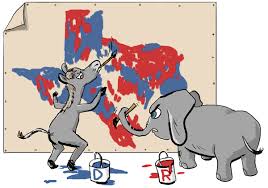
Americans are sick and tired of political gerrymandering that renders their votes meaningless. They want the voters – not politicians — to choose their Representatives.
A majority of each party is opposed to the mid-decade redistricting to guarantee a party’s win in midterms. An overwhelming majority of voters nationally (77%) and in Florida (76%), Texas (74%), New York (78%), Illinois (75%), and California (80%) support independent commissions to draw district lines instead of state lawmakers. 64% of Republican and independent voters want a ban on mid-decade redistricting.
Even 60% of the voters who supported Donald Trump in 2024 want Congress to ban mid-decade redistricting. Yet he threatened Indiana that if the state Republicans didn’t pass a district map that gave the Republican House delegation a 9-0 sweep, all federal funding will be stripped from the state, roads will not be paved and major projects will stop. His warning was a brazen attempt at election interference.
The Supreme Court held that it is unconstitutional for the federal government to place a “gun to the head” of a state by threatening massive funding losses. Those funds are not discretionary political weapons. Any threat to strip highway funding would require clear statutory authority.
While both parties politically gerrymander, the Republicans make much more use of it. In 2022 Congress nearly passed the Freedom to Vote Act, that included a prohibition on partisan gerrymandering. The transformative bill passed the House and had majority support in the Senate. It stalled only because the Senate failed by two Republican votes to modify the chamber’s archaic filibuster rules to allow the bill to advance to an up-or-down floor vote.
In some states, the party that wins the most votes overall doesn’t win a proportional number of seats. For example:
- Pennsylvania (2012): Democrats won roughly half the vote in House races, but Republicans won about 75% of the seats due to how the lines were drawn.
- North Carolina & Michigan: Similar representational mismatches have occurred.
The worst consequence of gerrymandering is that it frequently guaranties the election of the least qualified candidate. Take for example Jim Jordan, the 2024 Republican candidate for Ohio’s Fourth Congressional. The state Republican legislature mangled the district map to make it look like a jigsaw puzzle missing random pieces to make Jordan a sure winner even though he had the lowest score of all Republicans for legislative effectiveness, and despite that over the 800 bills he authored in 2023, none have passed and become law.
Sadly, Republicans will sail through the Supreme Court’s pro-Trump majority, even when Republicans violate the 15th Amendment by “deny or abridging the right to vote on account of race or color.”
In Alexander v. South Carolina NAACP the pro-Trump majority upheld the South Carolina Republicans’ legislature removal of 60% of Black voters from their Congressional District into a White-denominated District to ensure the election of the Republican candidate. The same majority, minus Barrett, previously held in Rucho. v. Common Cause that political gerrymandering is not the business of federal courts. The combination of these two rulings allows racial gerrymandering
because racial gerrymandering is always done to win elections.
In Brnovich v. Democratic National Committee Trump’s majority held that Arizona’s voting restrictions that allowed the tossing ballots that didn’t comply with the restrictions didn’t violate the Voting Rights Act (VRA) and 15th Amendment prohibitions against denying or abridging the right to vote based on race or color. Although Chief Justice Roberts admitted that Arizona’s restrictions fell more heavily on Native American minorities, he hedged by claiming that the number of ballots tossed would be immaterial to the outcome of the election, even though they exceeded the margins of victory in the 2018 and 2020 elections.
Twitter (X): https://x.com/ChaosPolicy/status/2023451660354511123?s=20