Leonard Leo spent $1.6 billion through opaque nonprofits and the Federalist Society to stack the Supreme Court with a conservative majority (“Leo’s Majority”) who butchered the Constitution to turn Leo’s priorities into law. Justice Thomas joked (humor is a vehicle for truth) that Leo was the “number 3 most powerful person in the world.”
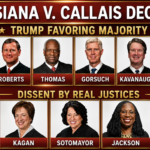
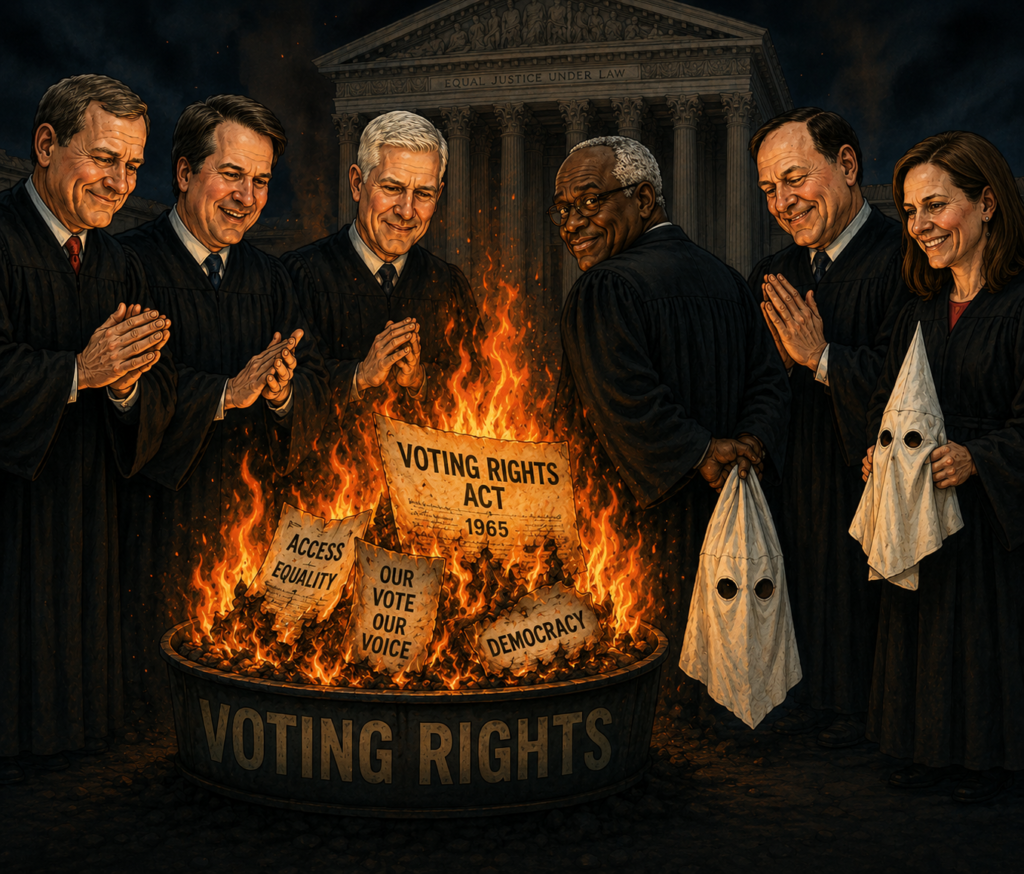
Leo’s appointees — Justices Roberts, Kavanaugh, Gorsuch, Thomas, Alito, and Barrett — just accommodated Leo by holding that the Constitution and the Voting Rights Act (the “VRA”) allowed Louisiana to use race in creating a district map, satisfying Leo’s hopes of denying blacks an equal opportunity to elect representatives. The holding was quickly exploited by six southern Republican state legislatures who redrew their maps to discriminate against black voters and convert minority-heavy districts into GOP seats.
In addition to rolling back anti-discrimination protections in voting, Leo’s priorities were: keeping Trump in office, deregulation of corporations, and restricting access to abortion.
His appointees complied on all fronts, even when it meant perverting the Constitution and defying the Supreme Court’s own precedent. The justices not chosen by Leo always filed strong and admonishing dissents.
Keeping Trump in office
- In Trump v. United States, Leo’s Majority gave Trump broad immunity and delayed his D.C. criminal trial until after the 2024 election so voters wouldn’t know that Trump was a convicted felon. By contrast, it took the Roberts Court just 16 days to decide Nixon wasn’t immune from prosecution and one day to make Republican George W. Bush president instead of Al Gore.
- Leo’s Majority worried that presidents would be chilled from taking bold action — a fabricated concern that other presidents’ conduct will be as egregious as Trump’s. As Justice Frankfurter held, “the process of Constitutional adjudication does not thrive on conjuring up horrible possibilities that … won’t happen again in the real world.”
- Leo’s Majority, bizarrely, remanded the case to the District Court to decide whether the January 6 attack on the Capitol was an official or unofficial act.
- That Trump, if inaugurated, could pardon himself.
States’ legislatures can racially discriminate to win elections.
- The Majority’s recent holding that state legislators can use race to gerrymander against minorities was preceded by other Constitutional violations.
- In Alexander v. South Carolina NAACP, Leo’s Majority upheld South Carolina’s Republican legislature’s right to move 60% of Black voters from their districts into a White-dominated district to ensure the election of the Republican candidate. Duh; isn’t the purpose of racial gerrymandering always to win elections?
- In Brnovich v. DNC, Leo’s Majority held that Arizona’s voting restrictions didn’t violate the VRA, which prohibits racial discrimination in elections. The law discarded votes cast in non-designated locations and prohibited third parties from collecting ballots for delivery to polling places other than family members, caregivers, or people who share the same household. But only 18% of Native Americans in rural counties receive mail at home, and most would have to travel two hours to reach a mailbox. Half don’t own cars and must rely on friends and neighbors, who are not allowed to help with transportation, which the law prohibits. Roberts admitted that Arizona’s restrictions fall more heavily on Native Americans, but that the consequences are small even though voters from the district were twice as likely as whites to have their ballots discarded. Nonetheless, Leo’s Majority decided that those disadvantages didn’t exceed “the usual burdens of voting.” To the contrary, the tossed votes exceeded the margins of victory in the 2018 and 2020 elections.
- In Shelby v. Holder, Leo’s Majority struck down Section 4(b) of the VRA, which required states with histories of suppressing minority voting to clear voting law changes with federal authorities. They relied on the 10th Amendment, which doesn’t mention elections. The 15th Amendment, which they didn’t cite, expressly prohibits racial gerrymandering and gives Congress the power to enforce that prohibition. Requiring federal pre-clearance for states with a history of racial voter suppression would seem to fall directly within that power. Shelby desperately invoked the antiquated theory of equal sovereignty (ES), which requires the federal government to treat states equally. But ES is nowhere in the Constitution; it’s not even a law. It was originally invented to prohibit different criteria in admitting states into the Union.
Deregulation of Corporations
- In Loper v. Raimondo, Leo’s Majority overturned Chevron v. NRDC, which held that courts should defer to an executive agency’s interpretation of ambiguous legislation — no longer. There, Leo’s Majority held that the Administrative Procedure Act requires courts to decide whether an agency’s interpretation of ambiguous language is correct. The holding transferred an enormous amount of policymaking from federal agencies, which require tens of thousands of workers, to the judiciary, the only unelected branch of government, which lacks the personnel to do the job. It was an indirect form of deregulation. Loper also unleashed a slew of corporate lawsuits challenging agency interpretations. The courts will now be loaded down with second-guessing agencies’ interpretations of ambiguous statutes.
Overturning Roe v. Wade
Leo found easy fodder in Thomas, Gorsuch, and Alito. The rest is history.
Leo’s appointees were conflicted since they repeatedly ruled in favor of Leo rather than what the Constitution required. In Caperton v. Massey, the Supreme Court had held that “every case … [and] every procedure which would offer a temptation to the average man … to not be impartial … denies … the due process of law.” Would Leo’s appointees feel beholden to the patron who got them on the bench and be tempted to favor their patron’s agenda? Of course they would.
Twitter (X): https://x.com/ChaosPolicy/status/2053875516604842135?s=20